Markets & Solutions
- Home
- Markets & Solutions
Markets & Solutions
Steel doesn't perform the same way in every context. A TMT rebar in a metro tunnel works differently from one in a multistoreyed housing complex or a factory shed. We've spent over two decades understanding those differences — and making sure the steel we produce is right for the job it's given.
Construction
Built Right. From the Ground Up
When someone builds a home, they’re not thinking about tensile strength or Fe grades. They’re thinking about whether the structure will hold. Whether it’ll last thirty years. Whether the money spent was worth it.
That’s the conversation we’ve had with builders, contractors, and structural engineers across Eastern India since 2004.
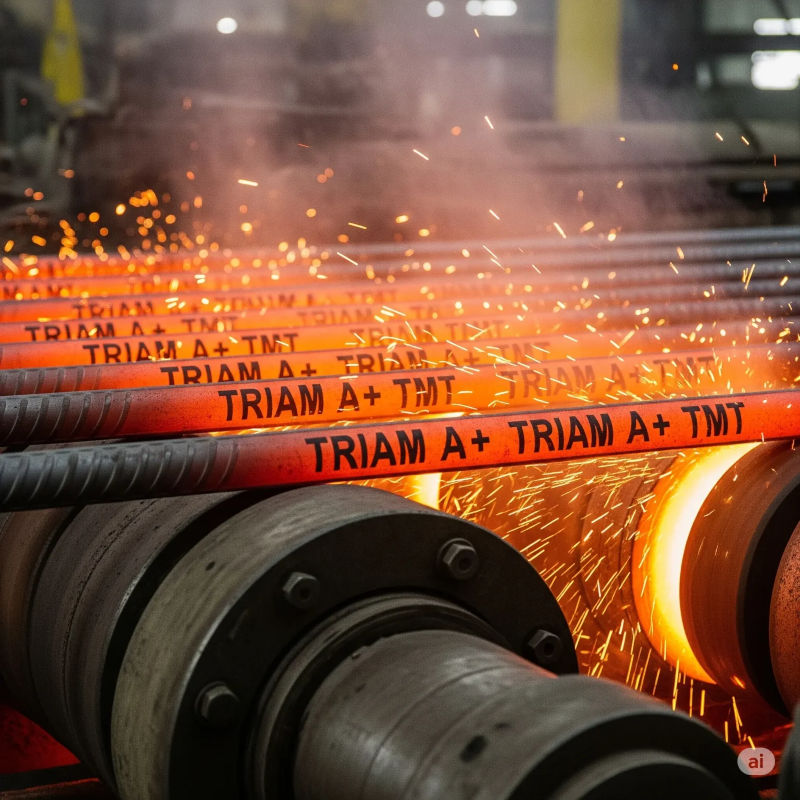
TRIAM A+ FE 550D — our flagship TMT rebar manufactured at Durgapur using Thermex technology from HSE, Germany — is built for exactly this. It comes in diameters from 8mm to 40mm, carries IS:1786-2008 certification, and has a rib pattern that’s been tested for better bonding and load distribution.
Where it actually shows up:
- Residential housing — independent homes, multistoreyed apartments, G+2 to high-rise. The corrosion resistance matters more than most builders discuss upfront, especially in humid climates.
- Commercial construction — offices, retail complexes, institutional buildings where load calculations and column-beam connections demand a consistent grade.
- Affordable housing projects — government-assisted schemes where compliance with Bureau of Indian Standards is non-negotiable and quality audits happen at every stage.
FE 550D grade means higher tensile strength compared to the more common 415. In practical terms, that can reduce total steel consumption by approximately 20% without compromising structural integrity. For a mid-size residential project, that’s a number worth checking with your structural consultant.
Our dealer network of over 900 partners covers the eastern region. Material reaches site. That’s the basic expectation, and we take it seriously.
Infrastructure
Steel That Holds Up — Under Pressure, Over Decades.
Infrastructure projects don’t get second chances. A bridge, a metro corridor, an industrial road — these aren’t structures you retrofit after five years because the rebar underperformed.
TRIAM A+ FE 550D is approved by the Delhi Metro Rail Corporation (DMRC), PWD West Bengal, the Public Health Engineering Department of West Bengal, and West Bengal Medical Services Corporation, among others. These approvals aren’t marketing claims. They’re the result of material testing, documentation, and compliance review that takes time to earn and is straightforward to lose.
Our infra arm, Takshvi Infra, has delivered on the ground. The entire internal road network for Durgapur Steel Plant (DSP) of SAIL was built by us. So was the civil work for the 2×20 MW Power Plant at Durgapur Steel Plant. These aren’t small scopes.
Where our steel goes in infrastructure:
- Roads and industrial corridors — high load-bearing surfaces that need rebars with consistent elongation and strength properties under thermal and seismic stress.
- Bridges and flyovers — where weldability and corrosion resistance are as important as tensile grade.
- Metro and rail infrastructure — DMRC approval means the material has passed procurement-level scrutiny for one of India’s most demanding urban rail networks.
Public utilities and water infrastructure — PHE-approved supply for water treatment structures, reservoirs, and related civil works.
Institutional and healthcare facilities — WB Medical Services Corporation and Haldia Development Authority projects where compliance is mandatory, not optional.
We’re also the sole convergent agent for SAIL in the eastern region. That relationship exists because of supply reliability and material quality — both of which have been tested at scale.
FMCG / Industrial
Steel for Facilities That Can't Afford Downtime.
FMCG and industrial facilities have different demands from construction steel. The structures they build — factories, warehouses, processing units, conveyor sheds, storage hangars — go through continuous mechanical stress, chemical exposure, and temperature variation. The steel holding those structures together needs to perform without needing attention.
This is where grade discipline matters.
Industrial clients we work with typically need:
Manufacturing Plants & Processing Units Factories running 24×7 rely on columns, beams, and mezzanine structures that were built to spec and haven’t shifted. TRIAM A+ FE 550D’s higher elongation value gives these structures the ductility to absorb vibration and dynamic loading — relevant for facilities running heavy machinery.
Warehouses & Logistics Hubs Structural rebars for large-span storage facilities, including loading bay overhangs and mezzanine storage levels, where uniformity of grade across the entire supply lot is critical. We supply to projects where the structural engineer has specified Fe550D for a reason.
Cold Storage & Food Processing Infrastructure Facilities in this segment deal with moisture-rich environments year-round. Corrosion-resistant rebar isn’t a premium upgrade here — it’s a baseline requirement.
Industrial Shed Construction Pre-engineered building foundations, secondary structures, and plant expansion work for FMCG manufacturers expanding capacity across eastern India.
Our mining subsidiary, Amit Mines Pvt Ltd, also operates within industrial ecosystems directly — processing blast furnace and SMS slag for MS scrap extraction and segregation at plants like Bokaro Steel Plant (SAIL). Industrial clients working on slag management and material recovery have worked with us on these operational contracts.
The expectation from industrial clients is different from construction. Delivery schedules are tighter. Quantity consistency matters more. We’ve built our distribution infrastructure around that.
Work That Speaks for Itself.
Client: Steel Authority of India Limited (SAIL) — Durgapur Steel Plant
Scope: Internal road construction for the entire DSP plant complex
Executed by: Takshvi Infra Private Limited (Infra arm of Amit Alliance)
Durgapur Steel Plant is one of SAIL's major integrated plants in Eastern India. The internal road network at a facility of this scale — carrying heavy equipment, raw material vehicles, and daily operational traffic — needs to be built with precision and completed without disrupting active plant operations.
Takshvi Infra completed the full scope. The project required coordination with SAIL's plant management teams, adherence to material and safety specifications set by a public-sector undertaking, and on-time delivery in an active industrial environment.
It also led directly to the civil work contract for the 2×20 MW Power Plant at the same Durgapur facility.
Client: Steel Authority of India Limited
Scope: Wet leasing operations and material processing at Bokaro Steel Plant and other SAIL facilities
Executed by: Amit Metaliks Limited + Amit Mines Pvt Ltd
Amit Metaliks is SAIL's sole wet leasing agent for their TMT plants in eastern India — covering facilities at Jagdishpur (Uttar Pradesh) and Kangra (Himachal Pradesh). This is not a dealership arrangement. It's an operations and management contract, which means SAIL has trusted us to run their plant infrastructure.
Amit Mines Pvt Ltd operates at Bokaro Steel Plant to process and recover scrap from slag dumps — both for internal SAIL use and for consumption within our own group. The contract also covers segregation and transportation of muck, debris, and slag through mechanised systems.
These two contracts together represent a relationship with SAIL that spans production, logistics, and plant operations.
Project: Delhi Metro Rail Corporation infrastructure supply
Product: TRIAM A+ FE 550D TMT Rebars
Approval reference: DMRC procurement list (approved vendor)
Metro rail construction in India runs on approved vendor lists. Getting onto the DMRC list requires material testing, documentation review, and a procurement-level evaluation process that most steel suppliers don't clear.
TRIAM A+ FE 550D is on that list.
We supplied TMT rebars for DMRC projects — structures that carry lakhs of commuters daily and have zero tolerance for grade inconsistency. The material goes through the same production process at Durgapur: Thermex technology, ISI certification, rib geometry tested for bonding. What changes for metro supply is traceability — each lot is documented and traceable to the plant batch.
The DMRC approval is also what allows us to supply to other government infrastructure projects that use DMRC's vendor list as a quality benchmark.